Oxygen Analysers for Closed-Loop Combustion Control
Key Specifications
Overview- Measurement principle
- Zirconia probe, in-house designed
- Response time
- ~4 seconds
- Typical operating range
- 6-12% O₂ (Macrotec targets 10-12%)
- Mounting location
- Secondary chamber or flue gas outlet
- Control function
- Closed-loop feedback to combustion air fans
- Full measurement span
- [SPEC NEEDED: e.g. 0-25% O₂]
- Output signal
- [SPEC NEEDED: analogue/digital interface]
- Power supply
- [SPEC NEEDED]
Full sensor span, output interface and power supply are confirmed against the analyser's datasheet for each project. Contact our engineers to specify your installation.
A Zirconia Probe Closing the Loop on Combustion Air
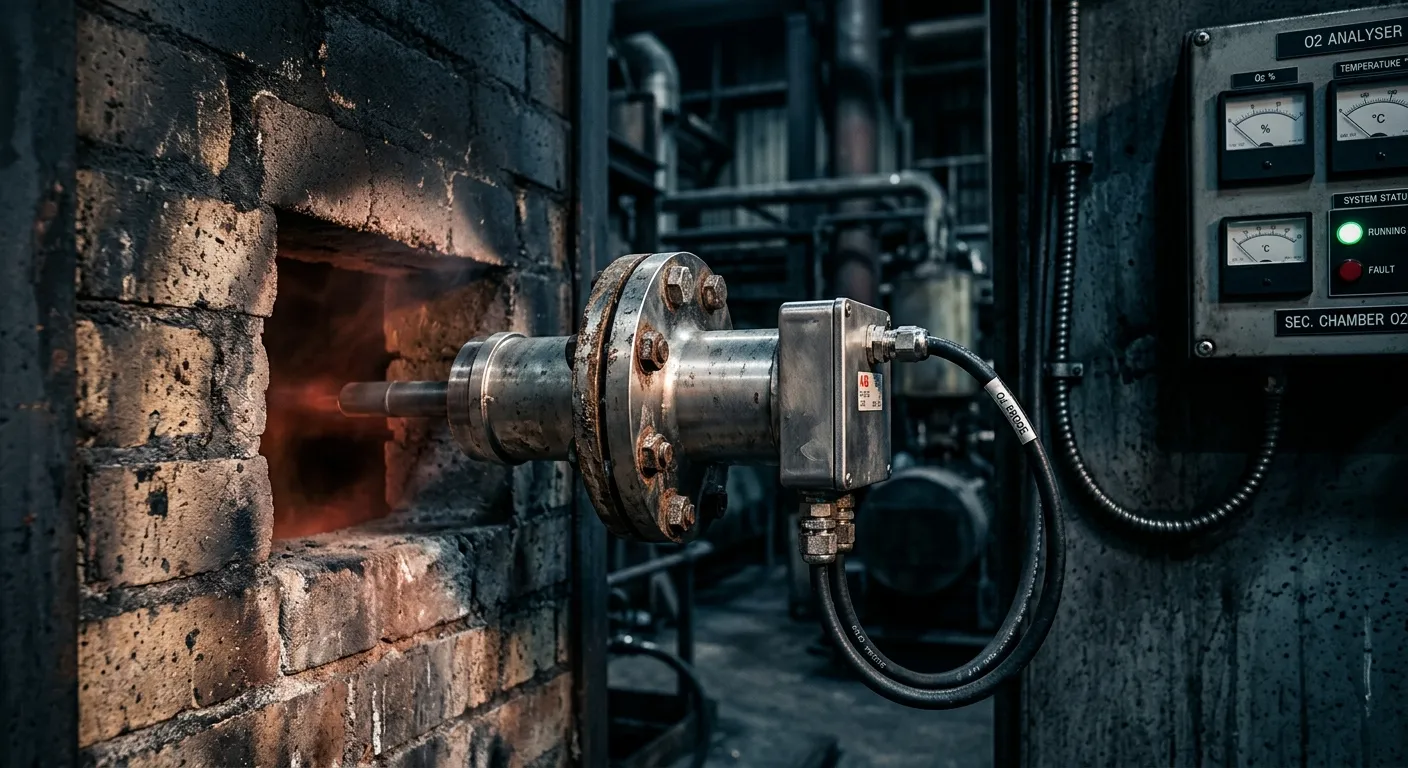
A zirconia sensor generates a voltage proportional to the difference in oxygen partial pressure across the ceramic cell, giving a continuous, direct reading of excess oxygen in the flue gas rather than an inferred estimate. Macrotec's own analyser is designed in-house and responds in around four seconds, fast enough to track a genuine shift in the waste stream rather than reporting a reading that is already out of date.
Excess oxygen is the figure that decides whether combustion is clean or wasteful. Too little oxygen and combustion is incomplete, driving up CO and other products of incomplete combustion; too much oxygen dilutes and cools the chamber, wasting auxiliary fuel for no destruction benefit. Systems typically hold 6-12% O₂ depending on design and waste type; Macrotec systems specifically target 10-12% O₂ as the operating band.
The reading feeds directly into the combustion air control system, adjusting variable-speed or damper-controlled combustion air fans in real time. This is the same closed-loop control philosophy described on our standard incinerators page, where a PLC monitors chamber temperature and adjusts burner firing automatically. The oxygen loop does the same job for air supply, so operators no longer estimate air requirements from waste type and quantity, a crude approach that inevitably swings between too much and too little air as the waste stream varies.
The downstream result is consistently lower CO, more complete destruction of waste, lower particulate carryover and more efficient use of fuel, which is also why oxygen control and combustion optimisation work go hand in hand.
- In-house zirconia probe, ~4-second response
- Targets 10-12% O₂ operating band
- Closed loop with combustion air fans
Combustion Control Wherever Waste Is Burned
Real-time combustion control feedback for incinerators, furnaces, boilers and cremators, and retrofit oxygen trim for existing thermal plant looking to cut fuel use and emissions without replacing the combustion chamber.
Incinerator secondary chamber control
Furnace & boiler combustion tuning
Waste-to-energy plant optimisation
Fuel efficiency programmes
Retrofit to existing thermal plant
Emissions reduction programmes
The Signal Behind Efficient Combustion
Fast-response zirconia sensor
A roughly four-second response means the control loop reacts to a genuine change in the waste stream, not a stale reading from a slower instrument.
Continuous flue-gas measurement
Excess oxygen is measured throughout the burn cycle, not spot-checked, so the control system always has a current figure to act on.
Feeds combustion air control
The signal drives variable-speed or damper-controlled combustion air fans directly, closing the loop without an operator estimating air requirements.
Improves fuel efficiency
Holding oxygen in the 10-12% target band avoids the wasted auxiliary fuel and heat loss that comes with running excess air through the chamber.
Lowers emissions
Neither starved nor over-diluted combustion produces consistently lower CO, more complete waste destruction and lower particulate carryover.
Designed and built in-house
Macrotec designs and manufactures its own oxygen analysers rather than reselling a third-party instrument, so support and spares come from the same team that built the unit.
The Control That Keeps Emissions in Check
Oxygen control is the feedback signal behind the combustion performance that keeps CO and other pollutant readings within the limits of the EU Industrial Emissions Directive (2010/75/EU) and South African NEM:AQA, working alongside our flue gas and dust analysers to verify it. The analyser itself is not independently certified to a specific EN measurement standard; our quality, environmental and occupational health and safety management systems are independently certified to ISO 9001, ISO 14001 and ISO 45001.
Standalone or Factory-Integrated
Oxygen analysers are supplied either as a standalone retrofit for existing plant or built into a new Macrotec incinerator's control panel at the factory, and are commonly specified alongside a dust analyser and flue gas analyser as one CEMS package.
Standalone / Retrofit
Fitted to an existing incinerator, furnace or boiler to add oxygen trim and closed-loop air control where none previously existed, without replacing the combustion chamber itself.
Factory-Integrated
Wired directly into the same PLC that manages burner firing and dampers on a new Macrotec incinerator, so temperature and oxygen control run as one system from day one.
Support, Maintenance & Spares
Because Macrotec designs and builds its own oxygen analysers in-house, calibration, servicing and spares support come directly from the engineers who built the unit, not a third-party instrument reseller. Readings also feed our Remote Monitoring dashboard, and our Maintenance & Repairs service covers on-site calibration and support wherever the unit is installed.
Specify Your Oxygen Analyser
Tell us about your combustion process and our engineers will help you specify the right oxygen analyser, standalone or fully integrated.