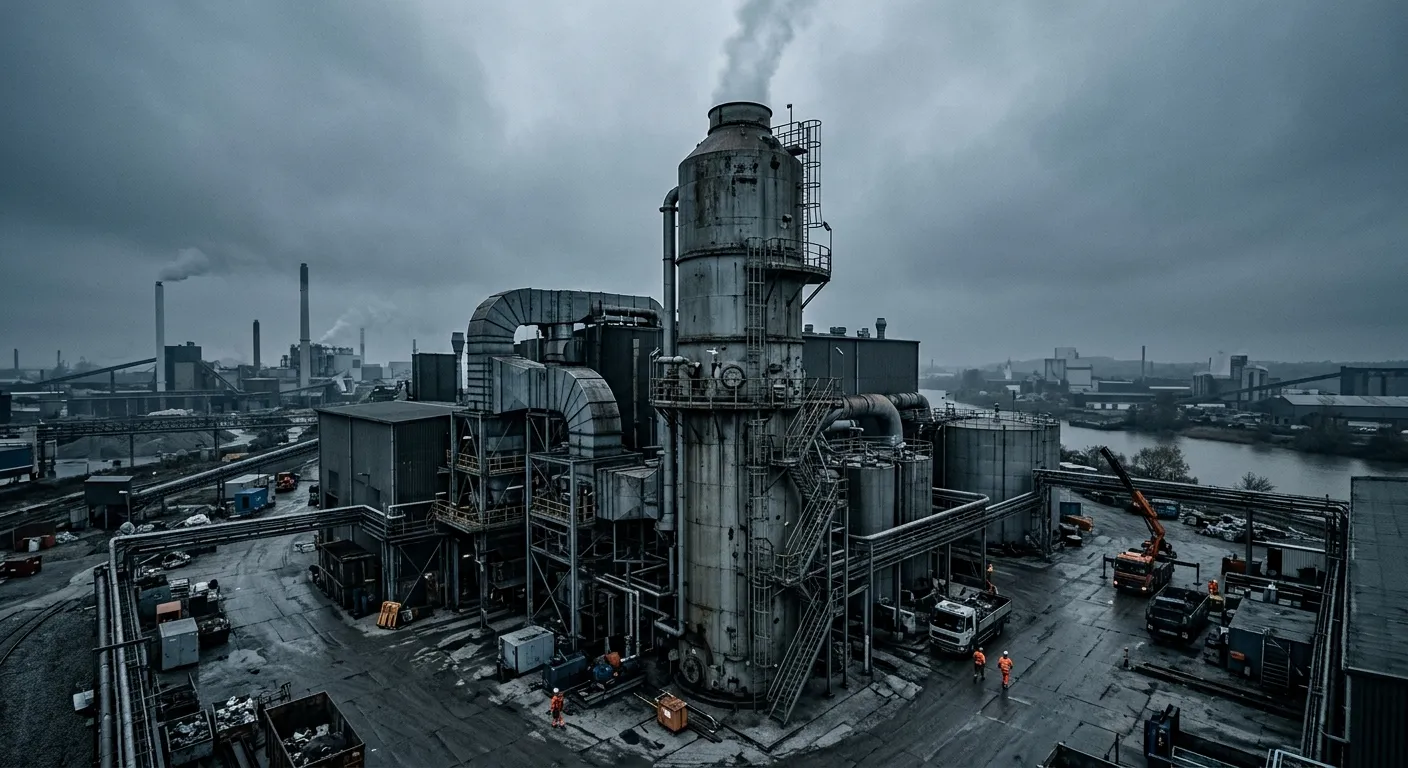
Incinerators Fitted with Wet Scrubbers
Key Specifications
Configuration overview- Model range
- V100 - V500
- Reagent
- Sodium hydroxide (NaOH) solution
- Acid gas removal
- High efficiency (exact figure [VERIFY])
- Targets
- HCl, SO₂ and HF
- Optional stage
- Activated carbon reactor
- Water requirement
- Continuous supply + effluent handling
- Emissions
- EU IED 2010/75/EU and SA NEM:AQA compliant
[VERIFY] Reagent dosing rate and removal-efficiency figures are pending confirmation from Macrotec's engineering team. Wet scrubbers are offered on the V100 to V500 models. See the full comparison tool for base incinerator specifications.
Alkaline Absorption of Acid Gases
Flue gas leaving the secondary chamber, already held at 850-1,100°C for the required residence time, is drawn into the scrubber vessel and brought into contact with a fine spray of alkaline solution. The spray both cools the gas stream and provides the surface area for acid gases to transfer from the gas into the liquid phase.
A sodium hydroxide (NaOH) solution reacts with hydrogen chloride, sulphur dioxide and hydrogen fluoride in the gas stream, neutralising them into soluble salts carried out in the scrubber liquor rather than passing to the stack. [VERIFY] exact removal efficiency and reagent dosing rate are confirmed per project against the incinerator model and expected acid-gas loading.
Where a site also needs to manage mercury, dioxins or other trace contaminants, an activated carbon reactor stage can be added downstream of the scrubber. Because the process uses water and produces an effluent stream, wet scrubbing suits sites with a reliable water supply and a route for treating or disposing of that effluent; where either is impractical, dry scrubbing with ceramic filtration reaches comparable compliance using no water at all.
- Neutralises HCl, SO₂ and HF
- Optional activated carbon reactor
- Available on V100 to V500
Built for High Acid-Gas Waste Streams
Healthcare risk waste and pharmaceutical residues, hazardous and chlorinated waste streams, animal and abattoir waste, and general or municipal waste at sites where a wet route is the practical fit for the available water supply and effluent handling.
Healthcare & medical waste
Hazardous waste & sludges
Animal & abattoir waste
Municipal & general waste
Mining & industrial residues
Hotels, lodges & resorts
One System, Sized as a Whole
Alkaline scrubbing, sized to the unit
The scrubber is specified as part of the incinerator project, sized to the flue gas volume and acid load of the specific model, not fitted as an afterthought.
NaOH neutralises acid gases
A sodium hydroxide solution absorbs hydrogen chloride, sulphur dioxide and hydrogen fluoride from the gas stream before it reaches the stack.
Quenches and cools the flue gas
The scrubbing spray cools the hot gas stream leaving the secondary chamber as it absorbs acid gases, reducing thermal stress on downstream ductwork.
Optional activated carbon reactor
Where a site also needs to control mercury, dioxins or other trace contaminants, an activated carbon reactor stage can be added downstream of the scrubber.
Handles high acid-gas loads
Wet scrubbing is well suited to waste streams with a high halogenated or sulphur content, where a dry route alone would need a larger dosing system.
One integrated control system
The scrubber's dosing and level controls are integrated with the incinerator's PLC, so operators run one system rather than two separate pieces of equipment.
Emissions and Safety, Independently Certified
Incinerators fitted with wet scrubbers are engineered to meet the emission and safety requirements that govern our clients' operations, including the EU Industrial Emissions Directive (2010/75/EU) and South African NEM:AQA, with the applicable limits and reagent dosing confirmed for each project. Our quality, environmental and occupational health and safety management systems are independently certified to ISO 9001, ISO 14001 and ISO 45001.
Available on V100 to V500
The wet scrubbing route is offered on the mid to high-capacity models, V100 through V500, where flue gas volumes justify the water supply and effluent handling the process requires. Wanting a dry alternative or need this technology for a source other than an incinerator? See dry scrubbing with ceramic filtration on the incinerator, or wet scrubbers as a standalone system for retrofitting to an existing process off-gas source.
Support, Maintenance & Spares
Wet scrubbers add reagent dosing, liquor and effluent handling to the maintenance schedule alongside the incinerator itself. Our Maintenance & Repairs service covers commissioning, operator training, spare parts and scheduled agreements for the complete system, not just the incinerator.
Specify Your Emission Limits
Tell us the acid gas limits your site must meet and our engineers will confirm whether a wet scrubber or dry scrubbing with ceramic filtration is the right fit.