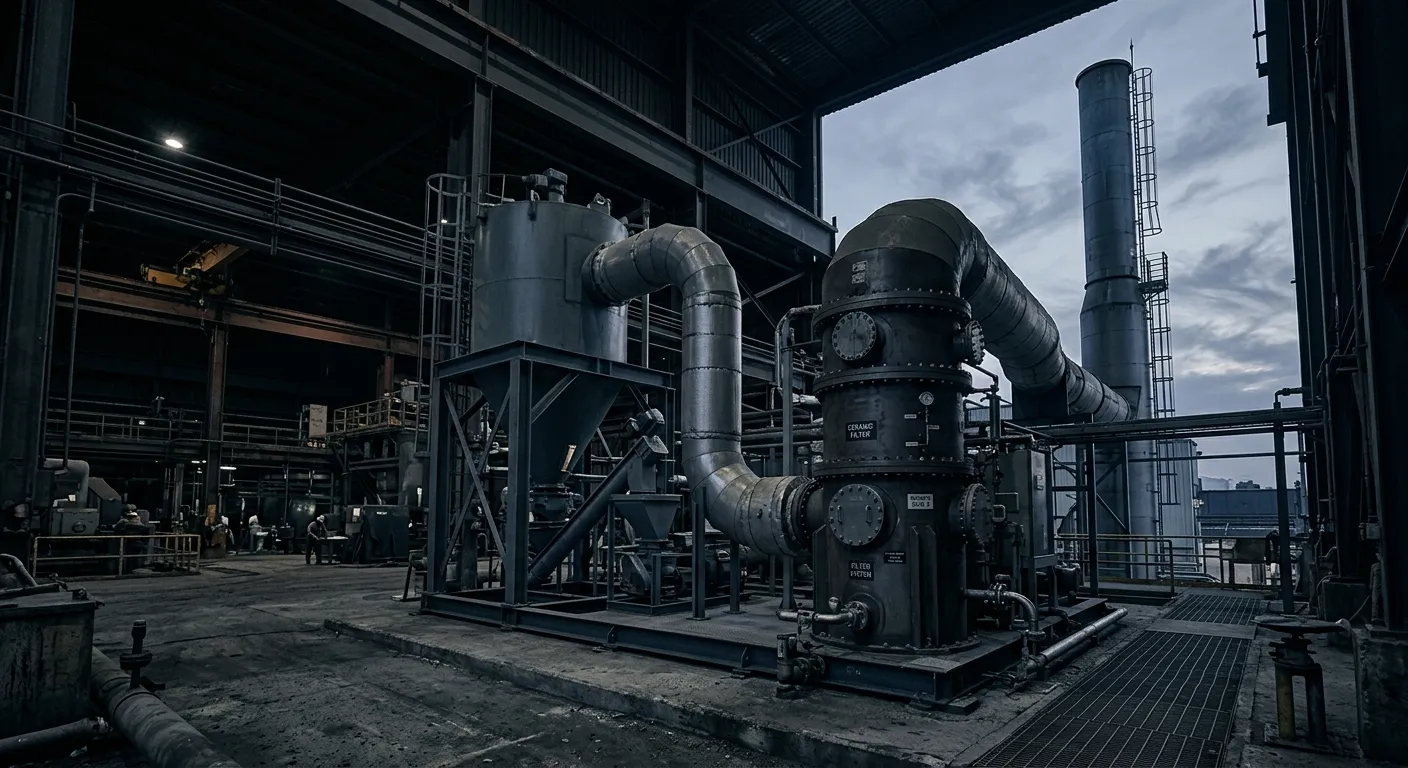
Ceramic Filtration Systems for Dry Scrubbing and Particulate Control
Key Specifications
Sized per project- Filtration efficiency
- Up to 99.99%
- Dosing agent
- Bicarbonate / activated carbon
- Target pollutants
- Acid gases, dioxins, metals, dust
- Water requirement
- None, dry process
- Element cleaning
- In-place reverse pulse
- Applicable gas volume
- [SPEC NEEDED]
- Inlet gas temperature range
- [SPEC NEEDED]
- Compliance
- BAT under EU IED
Figures marked [SPEC NEEDED] await confirmation from Macrotec's engineering team. Gas volume and inlet temperature are confirmed against your process during specification.
Dry Reagent Dosing and Ceramic Filtration, in One Pass
Sodium bicarbonate and/or activated carbon is injected directly into the hot flue gas stream, upstream of the filter bank. Bicarbonate reacts with acid gases, hydrogen chloride, sulphur dioxide and hydrogen fluoride, forming dry solid salts, while activated carbon adsorbs dioxins, mercury and other heavy metals onto its surface as the gas carries it downstream.
That gas, now carrying the original dust load plus the reaction products and spent carbon, then passes through the ceramic filter elements, the same rigid candle mechanism described on our filter elements page. A single filter bank captures everything in one pass, so one system does the work that would otherwise need separate dosing and filtration plant.
Removing acid gases while the gas is still hot, rather than after it has cooled downstream, also stops dioxins reforming further along the duct, a reaction that needs both cooling gas and residual chlorine to occur. That combination of dry dosing and high-temperature capture is why the technique is recognised as Best Available Techniques under the EU Industrial Emissions Directive.
The dosing skid, reactor and filter housing are supplied as one engineered system, sized to your process gas volume and pollutant loading, and retrofitted to an existing furnace, boiler or other combustion process off-gas duct, not only supplied new as part of a Macrotec incinerator.
- No water, no effluent treatment
- Combined acid-gas and particulate control
- Retrofits to any off-gas duct
Multi-Pollutant Control for Any Off-Gas Source
Any high-temperature off-gas stream needing combined acid-gas, dioxin and particulate control without a route for effluent treatment: industrial furnaces and boilers, incinerator and cremator stacks, cement, lime and minerals processing, foundries and smelters, and waste-to-energy plant.
Furnaces & boilers
Incinerator & cremator stacks
Foundries & smelters
Chemical & petrochemical
Waste-to-energy & municipal
Mining & metallurgy
One System, Two Pollutant Classes Controlled
Up to 99.99% filtration efficiency
Captures sub-micron particulate, PM2.5 and PM10 in the same pass as acid-gas neutralisation, rather than needing two separate pieces of plant.
Bicarbonate or activated carbon dosing
Reagent selection is matched to whether acid gases, dioxins and heavy metals, or both, must be controlled on your process gas stream.
No water, no effluent treatment
The dry process leaves no scrubber liquor to treat, licence or dispose of, cutting both capital cost and ongoing site burden compared with a wet route.
Prevents dioxin reformation
Removing acid gases at high temperature, before the duct cools, stops dioxins reforming downstream, unlike control measures applied only after the gas has cooled.
Self-cleaning reverse-pulse elements
The ceramic filter bank cleans itself in place, the same mechanism used on our standalone filter elements, so uptime does not depend on a manual change-out schedule.
Retrofits to existing plant
Supplied as a standalone system engineered around your existing furnace, boiler or process duct, not only as part of a new Macrotec incinerator.
Recognised as Best Available Techniques
Our ceramic filtration systems are specified against the emission limits that govern our clients' operations, supporting the EU Industrial Emissions Directive (2010/75/EU) and South African NEM:AQA, with dry scrubbing and ceramic filtration recognised as Best Available Techniques, and the applicable requirements confirmed for each project. Every element in the filter bank is cleaned by the same reverse-pulse mechanism used across our standalone filter elements. Our quality, environmental and occupational health and safety management systems are independently certified to ISO 9001, ISO 14001 and ISO 45001.
Specified to Your Gas Volume and Pollutant Loading
Dosing rate, reactor sizing and filter bank element count are engineered around your process gas volume, inlet temperature and pollutant loading, whether the system is retrofitted to an existing furnace or boiler, or supplied as part of a new Macrotec incinerator. If your site only needs acid-gas removal without full particulate polishing, our wet scrubber may be the simpler standalone option.
Support, Maintenance & Spares
Every ceramic filtration system is backed by Macrotec's after-sales team: on-site commissioning, reagent dosing calibration, a reliable supply of filter elements and spares, and maintenance agreements sized to your operation. Our Maintenance & Repairs service covers standalone systems wherever they are installed.
Specify Your Ceramic Filtration System
Tell us your gas volume, pollutant loading and emission limits and our engineers will help you specify the right ceramic filtration system for your process.