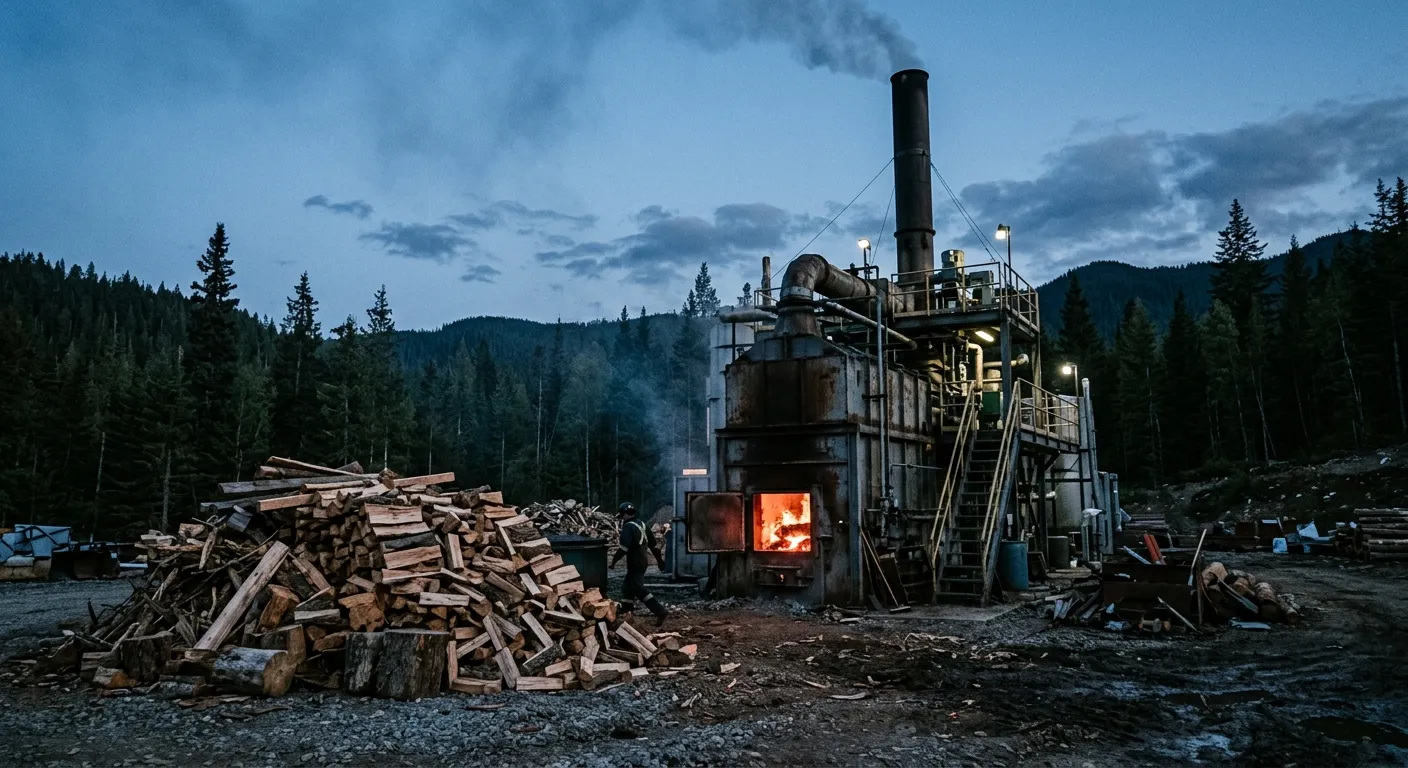
Biomass-Fuelled Incineration for Off-Grid Sites
Key Specifications
Configuration overview- Capacity
- 10 - 370 kg/hr (all models, V23-V500)
- Fuel
- Wood, briquettes or agricultural residues
- Operating temperature
- 850 - 1,100 °C
- Chambers
- 2 (primary + secondary)
- Residence time
- 2 - 4 seconds
- Operating mode
- Continuous, no preheat cycle
- Stack height
- 7 - 15 m
- Refractory rating
- 1,500 °C-rated [VERIFY]
- Grid dependence
- Off-grid option available
Biomass fuelling is available across the full V23-V500 range. See Standard Incinerators for the base platform, or the full comparison tool, for exact per-model figures.
Continuous Biomass Combustion, Not a Batch Burn
The biomass configuration uses the same two-chamber, controlled-air platform as the standard range, with wood, briquettes or agricultural residues in place of a diesel or gas burner as the primary heat source. Fuel is fed to the primary chamber, where it burns under a reduced air supply and drives waste in the chamber to the same sub-stoichiometric breakdown as a conventional unit.
Because biomass combustion is sustained continuously rather than started and stopped between loads, the unit does not need a preheat cycle before it reaches operating temperature, and it consumes less fuel overall than an equivalent batch-fired process would. The resulting gas stream still passes into a secondary chamber, where it is held at 850-1,100°C for a minimum residence time of two seconds, longer on the larger models, to complete destruction of organic compounds before the stack.
A PLC with operator HMI monitors chamber temperature and adjusts the fuel feed and combustion air accordingly, so the unit holds its set point without an operator manually managing the fire. The refractory and insulation, and the 7 to 15 metre stack heights, carry over unchanged from the standard range, which is what makes biomass a fuel-source option rather than a different machine.
- Wood, briquettes or agricultural residues
- Continuous operation, no preheat cycle
- Available across V23 to V500
Built for Sites Fuel Logistics Cannot Reach
Remote mines and camps, forestry and agricultural operations with a ready biomass supply, hotels and lodges without a diesel resupply route, and municipal or healthcare waste streams at sites where fossil fuel logistics are the constraint, not the waste itself.
Mining & remote camps
Hotels, lodges & resorts
Forestry & agricultural residue
Animal & abattoir waste
Municipal & general waste
Healthcare & medical waste
Fuel Independence Without a New Machine
No diesel or gas supply required
Wood, briquettes or agricultural residues replace fossil fuel entirely, so the unit keeps running where fuel logistics, cost or availability would defeat a conventional incinerator.
Continuous operation, no preheat
The unit holds temperature through continuous running rather than stop-start batch cycles, so there is no preheat cycle to plan around and no cooldown between loads.
Lower fuel consumption
Continuous combustion uses biomass more efficiently than a batch cycle would, reducing the volume of fuel that has to be sourced, stored and handled on site.
Improved emissions control
The more controlled, continuous combustion process improves emissions compared with batch-fired alternatives, and can be paired with wet or dry scrubbing where limits demand more.
Tall-stack dispersion
Stack heights of 7 to 15 metres, carried over from the standard range, disperse combustion gases well clear of ground level, an important consideration at camps and lodges.
Off-grid ready
An off-grid configuration is available for sites without a reliable electricity supply, extending the same platform to locations a grid-dependent incinerator could not serve.
Emissions and Safety, Independently Certified
The biomass configuration is engineered to meet the emission and safety requirements that govern our clients' operations, including the EU Industrial Emissions Directive (2010/75/EU) and South African NEM:AQA, with the applicable limits confirmed for each project. Where a site's limits require more than combustion control alone, add a wet scrubber or dry scrubbing with ceramic filtration without changing the base incinerator. Our quality, environmental and occupational health and safety management systems are independently certified to ISO 9001, ISO 14001 and ISO 45001.
Available Across the Full Range, V23 to V500
Unlike the wet and dry emission-control routes, biomass fuelling is not limited to the larger models: it is available on every unit in the range, from the compact V23 through to the high-capacity V500, with an off-grid configuration for sites without a reliable electricity supply. Combine it with a wet scrubber or dry scrubbing and ceramic filtration if local emission limits require it.
Support, Maintenance & Spares
Every biomass incinerator is backed by Macrotec's after-sales team: on-site commissioning, operator training, a reliable spare parts supply, and maintenance agreements sized to your operation, wherever it is installed. Our Maintenance & Repairs service covers the full range, including remote and off-grid sites.
Specify Your Biomass Incinerator
Tell us your fuel supply, waste type and throughput, and our engineers will help you size the right model and confirm whether an off-grid configuration suits your site.