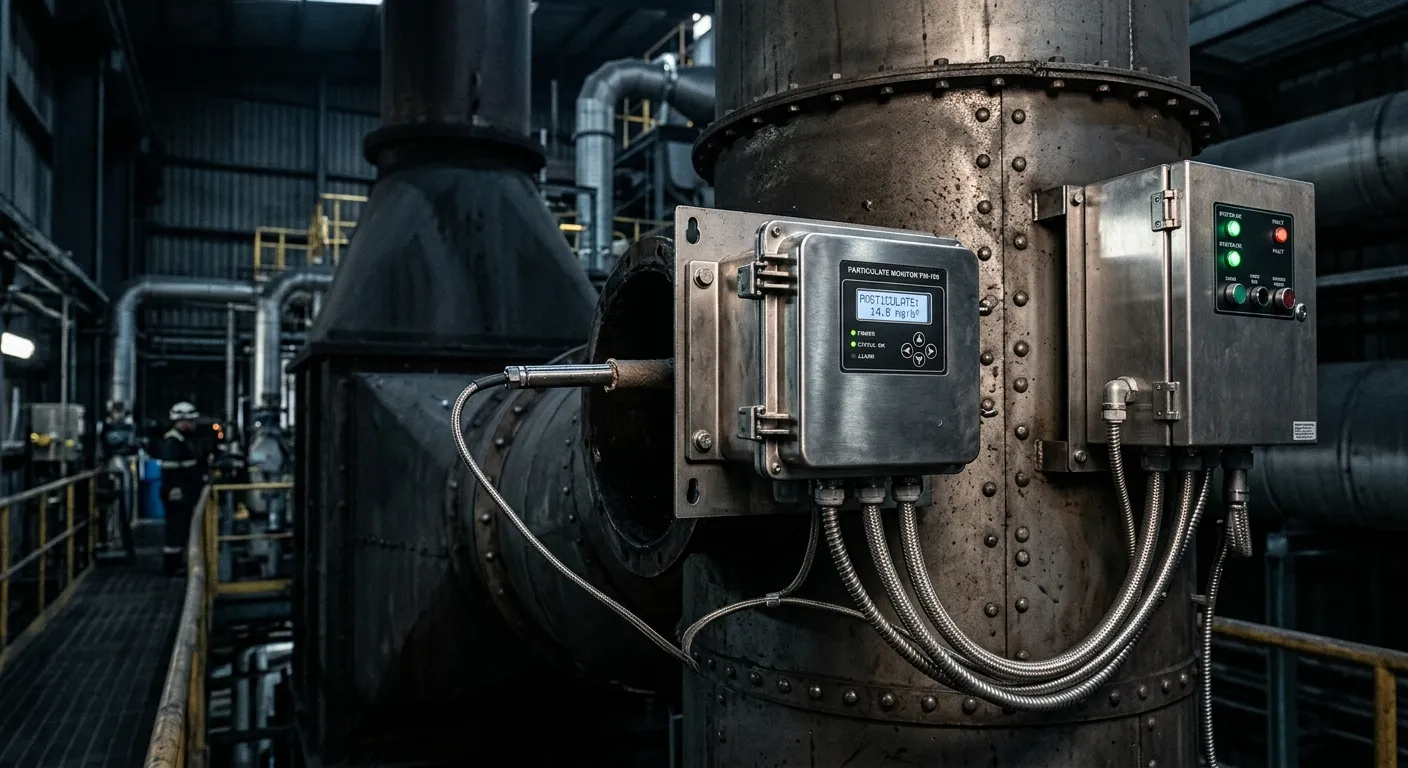
Continuous Dust and Particulate Analysers
Key Specifications
Overview- Measurement parameter
- Particulate matter (dust) in stack gas
- Measurement principle
- [SPEC NEEDED: optical or triboelectric sensor]
- Measurement range
- [SPEC NEEDED: mg/m³ span]
- Measurement mode
- Continuous, real-time
- Mounting
- In-stack or in-duct, direct fit
- Output signal
- [SPEC NEEDED: analogue/digital interface]
- Data logging
- Automatic, integrated with monitoring dashboard
- Power supply
- [SPEC NEEDED]
Sensor technology, measurement range and output interface are confirmed against the analyser's datasheet for each project. Contact our engineers to specify your installation.
Measuring Dust Loading in the Stack, Continuously
Instead of a stack tester visiting site for a handful of periodic manual samples, the analyser sits in the stack or duct permanently and reports a dust reading continuously. That gives operators a complete record of what actually left the plant across every hour of operation, not just the hours the sample happened to be taken.
Continuous particulate instruments generally work on one of two principles: optical, where light scattered or obscured by dust in the gas stream is measured, or triboelectric, where the electrical charge generated as particles strike a probe is measured directly. [VERIFY: confirm which principle Macrotec's own analyser uses before launch.] Both are established, continuous, non-contact-sampling approaches used across industrial stack monitoring.
The reading matters because it is the direct check on whatever is downstream of the combustion chamber. A steady baseline confirms ceramic filtration or a wet scrubber is performing as designed; a rising trend is often the first sign that a filter element needs attention, long before the plant is anywhere near its emission limit. The EU Industrial Emissions Directive sets a daily average particulate limit of 10 mg/Nm³, normalised to 11% O₂, dry gas, 273.15 K and 101.3 kPa, which is the benchmark a continuous dust reading is measured against.
Readings feed straight into the same monitoring dashboard as the rest of the plant, so the compliance record and the maintenance trigger come from a single, automatically logged data stream rather than a separate manual process.
- Continuous, real-time mg/m³ readings
- Direct fit, in-stack or in-duct
- Automatic, auditable compliance logging
Where Continuous Dust Monitoring Matters
Fitted to incinerator and cremator stacks, furnace and boiler flues, and precious metals recovery furnaces on mine sites, wherever a stack's particulate emissions must be measured, reported and kept within limit.
Incinerator & cremator stacks
Furnace & boiler flue gas
Mining & precious metals recovery
Waste-to-energy & municipal
Confirming APC & filtration performance
Regulatory stack testing support
A Live Check on What Leaves the Stack
Continuous particulate measurement
The stack is measured through the full operating cycle instead of a handful of periodic manual samples, so a short-lived exceedance cannot pass unnoticed between test dates.
Real-time mg/m³ readings
Operators see current dust loading on the dashboard as it happens, rather than waiting days for a laboratory report on a stack test that has already ended.
In-stack or in-duct mounting
Fits directly to a new Macrotec incinerator or retrofits onto an existing stack or duct, so the same monitoring approach works whether the plant is new or already installed.
Automatic compliance logging
Readings are logged without an operator maintaining a paper record, producing the auditable history a regulator or auditor can be shown on request.
Confirms filter performance
A rising baseline reading is often the first sign that ceramic filter elements or a wet scrubber need attention, well before an emission limit is at risk.
Alerts on emission drift
A gradual drift away from normal readings triggers an alert, giving operators time to investigate and correct it before it becomes a reportable breach.
Data You Can Report With Confidence
Continuous dust readings feed the auditable emissions record that supports compliance monitoring under the EU Industrial Emissions Directive (2010/75/EU) and South African NEM:AQA, with the applicable particulate limit confirmed for each project. The analyser itself is not independently certified to a specific EN measurement standard; our quality, environmental and occupational health and safety management systems are independently certified to ISO 9001, ISO 14001 and ISO 45001.
Standalone or Factory-Integrated
Dust analysers are supplied either as a standalone retrofit or built into a new incinerator at the factory, and are commonly specified alongside a flue gas analyser and oxygen analyser as one CEMS package.
Standalone / Retrofit
Fitted to an existing stack or duct with its own power and data connection, suited to sites monitoring a legacy incinerator, furnace or boiler that predates continuous monitoring.
Factory-Integrated
Supplied and wired into a new Macrotec incinerator's control panel at build, sharing the same PLC, HMI and monitoring dashboard as the rest of the plant.
Support, Maintenance & Spares
Control systems and instrumentation are designed and built in-house at Macrotec, so calibration, servicing and spares support come directly from the people who built the analyser, not a third-party reseller. Readings also feed our Remote Monitoring dashboard, and our Maintenance & Repairs service covers on-site calibration and support wherever the unit is installed.
Specify Your Dust Analyser
Tell us about your stack and reporting requirements and our engineers will help you specify the right dust analyser, standalone or fully integrated.