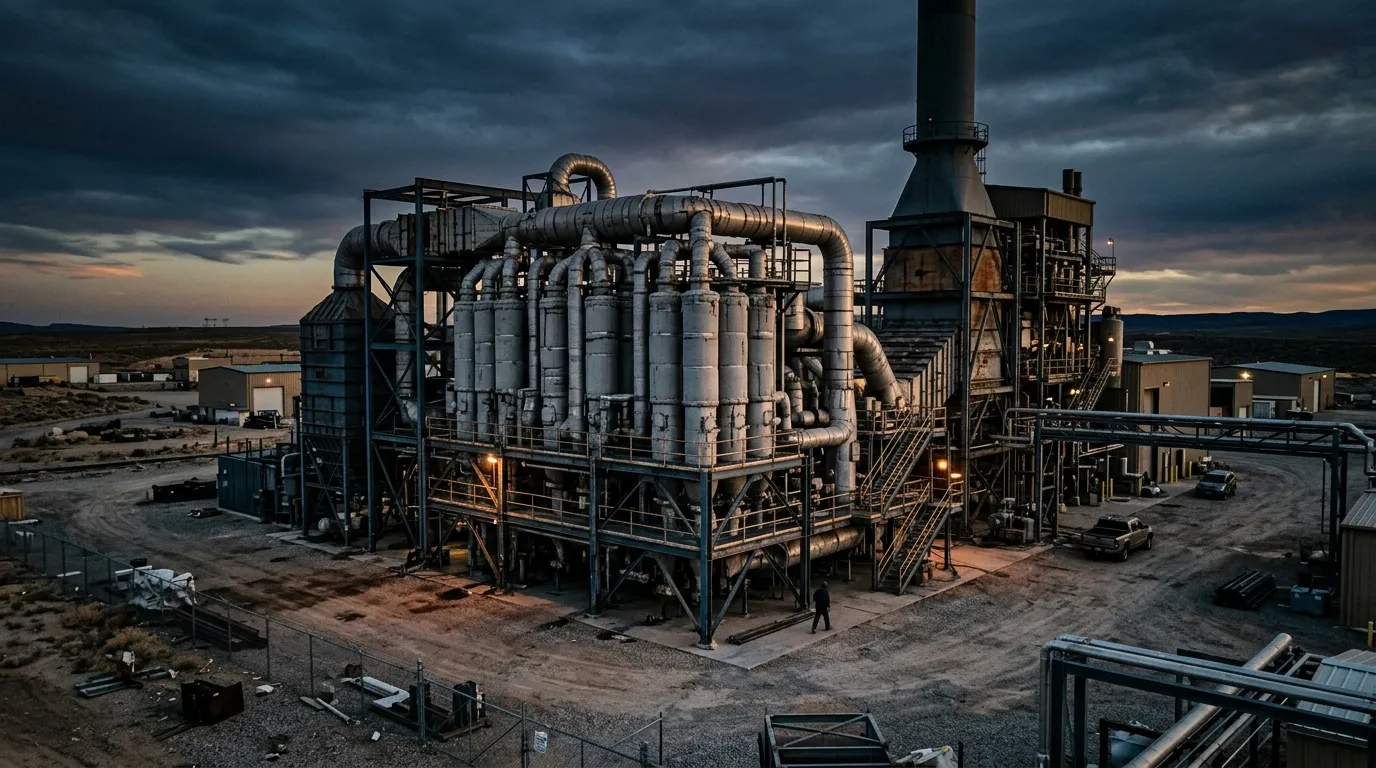
Incinerators Fitted with Dry Scrubbing and Ceramic Filtration
Key Specifications
Configuration overview- Model range
- V100 - V500
- Dosing agent
- Sodium bicarbonate and/or activated carbon
- Filtration efficiency
- Up to 99.99%
- Particle size
- Sub-micron, PM2.5 and PM10
- Water requirement
- None, dry process
- Element cleaning
- Self-cleaning, reverse pulse
- Feed
- Auto-feeder standard on this route
- Recognition
- Best Available Techniques (BAT) under EU IED
Dry scrubbing and ceramic filtration are offered on the V100 to V500 models. See the full comparison tool for base incinerator specifications.
Dry Dosing, Then Ceramic Filtration
Flue gas leaving the secondary chamber, already held at 850-1,100°C for the required residence time, is dosed with a dry reagent, sodium bicarbonate and/or activated carbon, injected directly into the gas stream. The bicarbonate reacts with acid gases including HCl, SO₂ and HF, while activated carbon adsorbs heavy metals such as mercury and dioxins onto its surface.
Because this dosing takes place while the gas is still hot, acid gases are removed before the stream cools further, which is what prevents dioxins reforming downstream, a failure mode that a purely cool, wet process is more prone to. The dosed gas then passes through ceramic filter elements, which capture the resulting solids along with sub-micron particulate, PM2.5 and PM10, at up to 99.99 percent efficiency.
The elements are self-cleaning by reverse pulse: compressed air periodically dislodges the collected solids from the outside of each element into a hopper below, so filtration continues without stopping to change a filter medium. Because the entire process is dry, there is no water supply to secure and no effluent to treat, which is why this route is recognised as Best Available Techniques under the EU IED. Where a site has a reliable water supply and prefers it, wet scrubbing reaches comparable acid-gas compliance by a different route.
- No water, no effluent treatment
- Up to 99.99% filtration efficiency
- Available on V100 to V500
Built for Sites Where Water Is Scarce or Impractical
Healthcare risk waste and pharmaceutical residues, hazardous and heavy-metal-bearing waste streams, animal and abattoir waste, and general or municipal waste at sites where a water supply or effluent route for wet scrubbing is not available or not practical to build.
Healthcare & medical waste
Hazardous waste & sludges
Animal & abattoir waste
Municipal & general waste
Mining & industrial residues
Hotels, lodges & resorts
Compliance Without a Water Problem
Dry scrubbing, sized to the unit
Sodium bicarbonate and/or activated carbon dosing is specified as part of the incinerator project, matched to the flue gas volume and expected acid-gas and dioxin loading of the specific model.
No water, no effluent treatment
Because the scrubbing is dry, there is no water supply to secure and no effluent stream to treat, licence or dispose of, removing an entire category of site infrastructure.
Up to 99.99% filtration efficiency
Ceramic elements downstream of dosing capture sub-micron particles, PM2.5 and PM10, to a level fine particulate emissions require and coarse filtration cannot reach.
Self-cleaning reverse-pulse elements
Elements are cleared by reverse pulse rather than manual replacement of a filter medium, keeping pressure drop and maintenance labour down over the operating life of the elements.
Prevents dioxin reformation
Removing acid gases and adsorbing contaminants at high temperature, before the gas cools further, prevents dioxins reforming downstream, which is why the combination is recognised as Best Available Techniques.
Auto-feeder standard on this route
Units specified with dry scrubbing and ceramic filtration ship with an automatic waste feeder as standard, matching feed consistency to the dosing and filtration stage downstream.
Emissions and Safety, Independently Certified
Incinerators fitted with dry scrubbing and ceramic filtration are engineered to meet the emission and safety requirements that govern our clients' operations, including the EU Industrial Emissions Directive (2010/75/EU) and South African NEM:AQA, with the applicable limits confirmed for each project. The combination of high-temperature dry dosing and ceramic filtration is recognised as Best Available Techniques (BAT) under the EU IED. Our quality, environmental and occupational health and safety management systems are independently certified to ISO 9001, ISO 14001 and ISO 45001.
Available on V100 to V500, Auto-Feeder Standard
Dry scrubbing and ceramic filtration is offered on the mid to high-capacity models, V100 through V500, and ships with an automatic waste feeder as standard on this route. Prefer a wet route, or need this technology for a source other than an incinerator? See wet scrubbing on the incinerator, or ceramic filtration as a standalone system for retrofitting to an existing process off-gas source.
Support, Maintenance & Spares
Ceramic elements and dosing systems are consumables with their own service schedule alongside the incinerator itself. Our Maintenance & Repairs service covers commissioning, operator training, replacement elements, reagent supply and scheduled agreements for the complete system, not just the incinerator.
Specify Your Emission Limits
Tell us the emission limits your site must meet and our engineers will confirm whether dry scrubbing with ceramic filtration or a wet scrubber is the right fit.